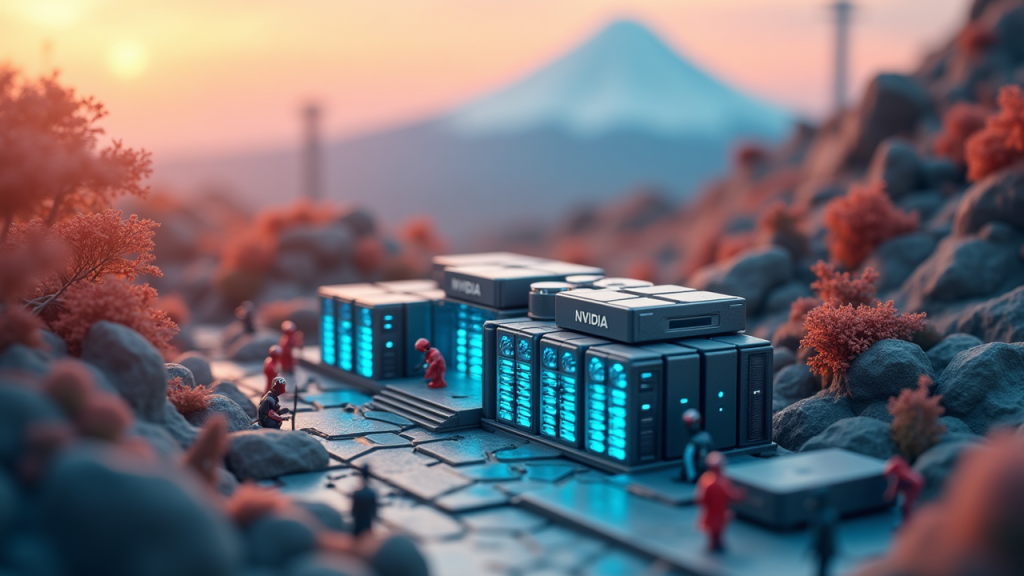
Japan is taking a bold step to secure its place in the global AI race. On July 16, 2026, the Japanese government, led by the Ministry of Economy, Trade and Industry (METI), alongside industrial leaders and NVIDIA, announced the launch of the world’s first national AI infrastructure. The centerpiece is the NVIDIA Vera Rubin AI factory, built in partnership with Noetra Corp., featuring 13,750 NVIDIA Vera CPUs and 27,500 NVIDIA Rubin GPUs. This 140-megawatt facility will run on the NVIDIA DSX platform with Spectrum-X Ethernet networking and BlueField DPUs, forming the backbone of Japan’s FRONTia Project to develop open multimodal foundation models for physical AI.
Why This Matters: A National AI Infrastructure Blueprint
Unlike previous AI data centers built by private cloud giants like Microsoft or Google, this project is a government-led, public-private partnership aimed at treating AI as a national strategic asset. Japan’s goal is to accelerate physical AI—AI that operates in the real world—for applications such as AI agents, digital twins, robotics, and intelligent manufacturing. By sharing pretrained model weights broadly with domestic developers and providing software like NVIDIA Nemotron, Cosmos, Isaac GR00T, and NeMo, Japan aims to democratize AI development and support its AI robotics strategy toward 2040. This move positions Japan as a pioneer in national AI infrastructure, potentially setting a precedent for other countries.
XPLAIN AI’s Interpretation: Beyond the Headlines
While the announcement is undeniably bullish for NVIDIA’s AI narrative, XPLAIN AI notes a historical pattern: according to Rhea-AI analysis, past AI-related announcements from NVIDIA have often been followed by an average share price decline of about -1.2%, suggesting a “sell the news” reaction. Additionally, recent net insider selling of 1,901,125 shares warrants caution. In our view, the market may have already priced in much of NVIDIA’s AI infrastructure potential. However, the long-term significance of this project cannot be overstated. It validates NVIDIA’s next-generation hardware at a national scale and opens a new market beyond hyperscalers. For Japan, it’s a strategic move to reclaim leadership in manufacturing and robotics through physical AI. The success of this model could influence other nations to follow suit, creating a new demand vector for AI chips and infrastructure.
Beneficiaries and Risks: Ecosystem Winners and Losers
The direct beneficiaries are NVIDIA and its ecosystem partners. NVIDIA (NVDA) supplies the full hardware stack—CPUs, GPUs, networking—and gains a flagship reference for national AI projects. Noetra Corp. gains large-scale data center construction and operation experience. Japanese AI, robotics, and manufacturing companies get access to open models and infrastructure to develop physical AI applications.
- Potential beneficiaries: NVIDIA (NVDA), Noetra Corp. (private), Japanese AI/robotics firms leveraging open models.
- Potential risks/competitors: AMD (AMD) and Intel (INTC) may lose ground in national AI infrastructure deals. Cloud providers like Oracle or AWS could face competition from government-backed infrastructure.
Counter-Scenario and Uncertainties
We must also consider potential headwinds. Japan’s budget execution could face delays, or the commercialization of physical AI might be slower than expected, limiting the project’s immediate impact. Global AI chip supply constraints could also disrupt hardware procurement. Investors should watch for follow-on national AI contracts for NVIDIA and tangible progress in physical AI model development by Japanese companies.
Key Metrics to Monitor
Going forward, key indicators include: (1) NVIDIA’s additional national AI infrastructure deals, (2) adoption of the FRONTia Project’s open models by Japanese industry, (3) any insider trading patterns at NVIDIA, and (4) competitor responses from AMD and Intel. The next 12 months will reveal whether this is a one-off or the start of a global trend.
#Japan #AIInfrastructure #NVIDIA #PhysicalAI #NationalAIStrategy #Robotics #Manufacturing #DataCenter
Sources
- Japan Government, Industrial Leaders and NVIDIA Launch the World’s First National AI Infrastructure | NVDA Stock News — Latest News | Stock Titan · News coverage · Thu, 16 Jul 2026 08:00:00 GMT
Written by: XPLAIN AI Editorial Team · Reviewed by: XPLAIN AI Editorial Desk
This content was drafted with AI assistance based on publicly available sources and reviewed under XPLAIN AI's editorial standards.