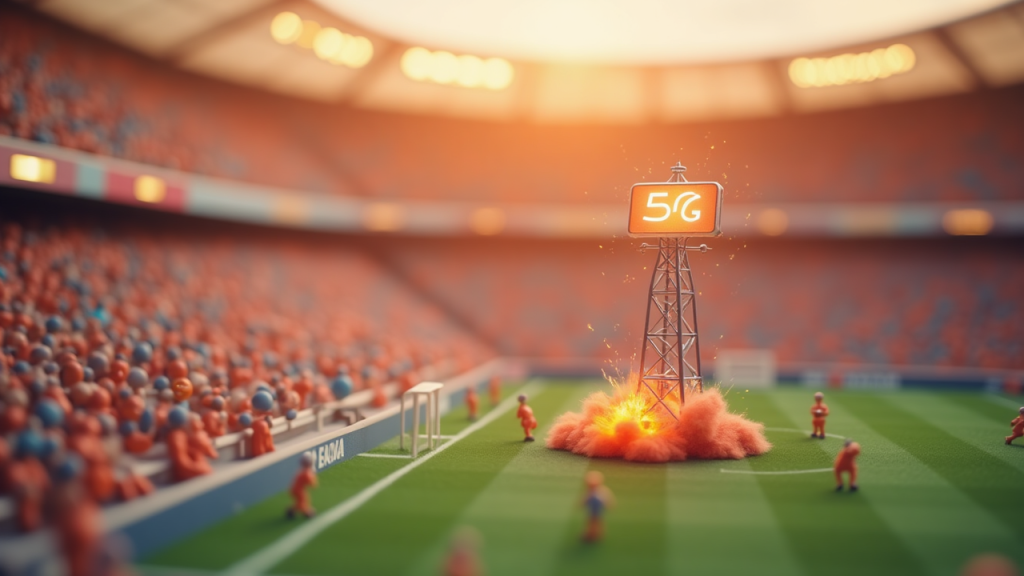
When Spain and Argentina face off in the 2026 FIFA World Cup final at the New York-New Jersey stadium, more than 80,000 fans will be in the stands and over a billion viewers will tune in globally. But the real action might happen during the 11-minute halftime show—the first ever in World Cup history—curated by Coldplay’s Chris Martin and featuring Madonna, Shakira, BTS, and Justin Bieber. As history shows, halftime shows often draw bigger audiences than the game itself: Kendrick Lamar’s Super Bowl LIX performance pulled 133.5 million viewers, and Bad Bunny’s Super Bowl LX show also edged out the game. That means a massive, simultaneous spike in mobile data usage as fans whip out their phones to capture the moment. Verizon, the official telecommunication services sponsor of the tournament, has been preparing for this for two years.
Verizon’s ‘Technology Layer Cake’ Strategy
Abraham Arencibia, Verizon’s vice president of technology and product development, describes the infrastructure as a ‘technology layer cake.’ The first layer is on the pitch: private 5G networks power referee body cameras and localized connectivity for low-latency, real-time data. The second layer handles the crowd’s data surge. With 60 to 100 cameras capturing content from the stands and a wireless network capable of supporting 50 terabytes of data, Verizon has increased network capacity by four times compared to standard operations. ‘Think of every single Netflix movie ever streamed at the same time for 90 minutes,’ Arencibia said. The most critical moments are kickoff and the start of the halftime show. ‘That is the moment that people are most excited about. They’re going to pull up their phone, and that’s when you see a spike in our network. We build for those first few minutes—if you survive that, everything else starts straightening up.’
The Digital Backbone: Broadcast Contribution Network
The final layer is the Broadcast Contribution Network (BCN), the digital backbone that funnels every camera feed, video asset, and data point from the host stadium to the International Broadcasting Center (IBC) in Dallas via 80,000 miles of fiber. Without this, billions of viewers worldwide couldn’t watch live. Verizon’s role as FIFA’s official telecom sponsor puts its network reliability on a global stage.
Our Analysis: Network Infrastructure as a Competitive Moat
This story goes beyond a telecom PR piece. It underscores how network capacity is becoming a critical competitive advantage in the AI and cloud era. Verizon (VZ) has a chance to prove its 5G Ultra Wideband network’s real-world performance on a massive scale. Success could drive demand for its solutions in future mega-events, live streaming, and metaverse gatherings. Conversely, rivals AT&T (T) and T-Mobile (TMUS) risk falling behind in network reliability marketing. The infrastructure buildout also benefits network equipment makers like Corning (GLW), Ericsson (ERIC), and Nokia (NOK), which supply fiber, antennas, and small cells. However, short-term stock impact for Verizon is limited, as telecom stocks are more sensitive to dividends and stability. The real value lies in long-term revenue streams from edge computing and AI-driven network optimization.
Risks and Uncertainties
The biggest risk is a network failure. If the network crashes during the halftime show, it would severely damage Verizon’s brand. Even with meticulous planning, unexpected traffic surges or equipment glitches could occur. Moreover, this is a one-off event; translating success into everyday network improvements is a separate challenge. Investors should monitor Verizon’s return on 5G investment (ROI) over time.
Key Takeaways
- Verizon has prepared for two years to handle massive data spikes during the first-ever World Cup halftime show.
- The infrastructure uses a ‘technology layer cake’ approach: private 5G on the pitch, enhanced capacity for the crowd, and a fiber backbone for global broadcast.
- Success could boost Verizon’s reputation and demand for its network solutions; failure poses a major brand risk.
- Network equipment makers like Corning, Ericsson, and Nokia may benefit from ongoing infrastructure investments.
Ultimately, this World Cup halftime show is a litmus test for network infrastructure limits. A success would reinforce that 5G is essential, not overhyped. A failure would raise doubts about network reliability at scale. Either way, the importance of network capacity in an age of exploding data traffic is only growing.
#WorldCup #HalftimeShow #Verizon #5G #NetworkInfrastructure #TelecomStocks #FIFA #DataTraffic #EdgeComputing
Sources
- How Verizon is preparing for record-setting network spikes during the first-ever World Cup halftime show — Fast Company · News coverage · 2026-07-19T10:01:00
Written by: XPLAIN AI Editorial Team · Reviewed by: XPLAIN AI Editorial Desk
This content was drafted with AI assistance based on publicly available sources and reviewed under XPLAIN AI's editorial standards.