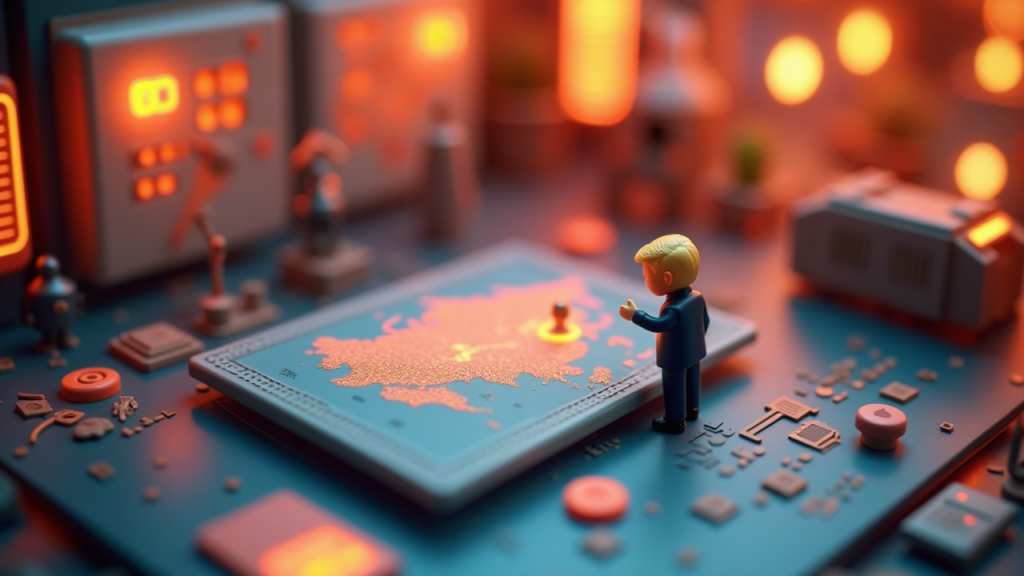
The US-China AI rivalry has entered a new phase. Once focused on chip export controls, Washington is now weighing far more disruptive measures: discouraging, restricting, or even blocking American companies from using Chinese AI models. According to an Axios investigation into the Trump administration’s evolving strategy, officials have explored multiple routes to curb access without a formal nationwide ban. The renewed push follows the launch of Moonshot AI’s Kimi K3, a powerful Chinese model that competes closely with leading US systems while offering open access and lower costs. This is no longer just a national security debate—it is a battle for control of the global AI market.
What Happened: Kimi K3 Ignites the Debate
The catalyst was Moonshot AI’s release of Kimi K3 on 17 July 2026. Reuters reported the model as a 2.8-trillion-parameter system, the world’s largest open-weight AI system, based on Moonshot’s claims. “Open-weight” means developers can download the core parameters, run the model on their own infrastructure, and adapt it for specific tasks—unlike closed services such as ChatGPT or Claude, where the provider keeps the model behind an online interface. This model challenges a comfortable Silicon Valley assumption: that the strongest systems will remain expensive, closed, and American. Chinese labs have increasingly competed through capable models that developers can customize and deploy at lower cost, threatening the pricing power of US incumbents.
Why It Matters: Security vs. Market Competition
Inside the Trump administration, several pathways have been discussed. Officials considered adding Chinese AI labs to the Commerce Department’s Entity List, forcing US companies to secure licenses before dealing with listed firms. Others proposed a government advisory warning companies about security threats linked to Chinese models, or requiring US cloud providers to guarantee the security of any Chinese model they host and accept liability if something goes wrong. Commerce officials reportedly circulated draft supply-chain rules targeting Chinese open-weight systems. Pro-innovation officials blocked these ideas earlier, but national security voices have gained influence as opposing advisers have left.
No public ban exists—yet. But the administration could achieve the same effect through procurement restrictions, compliance warnings, licensing threats, and public pressure. Companies may walk away from Chinese tools simply because legal risk becomes too difficult to price. Supporters argue that Chinese models could expose sensitive data, contain hidden vulnerabilities, or create dependencies on technology shaped by Beijing. Critics, however, see a different danger: regulation that protects OpenAI and Anthropic from cheaper competition. David Sacks, an outside White House AI adviser, warned that leading closed-model companies could use government policy to weaken open-source rivals.
Our Analysis: The Real Issue Is Security or Protectionism?
XPLAIN AI interprets this situation as less about whether every Chinese model is safe or unsafe, and more about whether the US government can separate genuine security controls from rules that quietly strengthen a small group of domestic companies. Kimi K3’s arrival changes the economics of AI for startups, universities, and smaller software firms—especially in emerging markets like South Africa, where access to high-end computing and dollar-priced software can be a serious barrier. If Washington makes Chinese models “legally radioactive,” American businesses may face fewer choices and higher AI costs, while the competitive pressure that drives innovation could diminish.
Potential Winners and Losers
- Potential beneficiaries: US closed-model AI providers (OpenAI, Anthropic) could strengthen pricing power and market share if Chinese open-source rivals are sidelined. US cloud providers (Amazon AWS, Microsoft Azure, Google Cloud) may benefit from reduced regulatory burden on hosting Chinese models and increased demand for US models.
- Potential risks: US startups and SMEs that rely on low-cost Chinese AI models face higher costs and reduced access. Nvidia and other AI chipmakers could suffer from tighter export controls to China. Chinese AI firms (Baidu, Alibaba) may see global expansion blocked.
Counter-Scenarios and Uncertainties
The outcome is not predetermined. First, opposition within the administration remains, and legal challenges or congressional oversight could slow action. Second, Chinese models might enter the US indirectly via third countries like Singapore or India, bypassing restrictions. Third, US companies may lobby against rules that raise their costs, seeking loopholes or delaying compliance. Finally, the European Union’s parallel push to tighten AI regulation (as reported by Europe Infos) could either clash with or complement US policy, creating additional complexity for global firms.
Key Indicators to Watch
Investors should monitor: (1) official executive orders or Commerce Department rules; (2) announcements from major US cloud providers about halting Chinese model hosting or disclosing related risks; (3) potential Chinese retaliation, such as restricting US AI firms’ access to China; (4) industry surveys on US startup model switching and cost changes. These indicators will signal how the market actually moves.
#AI #ChinaAI #TrumpAdministration #OpenSourceAI #AIRegulation #KimiK3 #AIInvestment #TechHegemony
Sources
- Trump’s Secret Battle Against Chinese AI Could Reshape Tech in 2026 — Memeburn · News coverage · Fri, 24 Jul 2026 10:19:59 +0000
- Europe tightens legal screws on AI content in 2026, putting Google, OpenAI and Meta under new pressure — Europe Infos · News coverage · Fri, 24 Jul 2026 08:28:15 +0000
Written by: XPLAIN AI Editorial Team · Reviewed by: XPLAIN AI Editorial Desk
This content was drafted with AI assistance based on publicly available sources and reviewed under XPLAIN AI's editorial standards.